Why Writing Pre-Planned TAT Stories Will Get You Rejected Instantly
You might look perfect on paper. You have excellent physical fitness, sharp communication skills, and an impressive academic record. Yet, many candidates with these exact traits find their psychological profile stamped with a decisive "Not Recommended."
The reason is almost always the same. They walk into the testing hall relying entirely on pre-written stories. Instead of reacting to the image on the screen, they shoehorn a coaching-center template onto the paper. This is the fastest route to a memorized TAT stories SSB rejection.
The Thematic Apperception Test is fundamentally a projective test. Assessors are not evaluating your creative writing skills; they are analyzing your subconscious reflexes. If you project a PDF manual instead of your own personality, you fail the authenticity check entirely. Let us deconstruct exactly how assessors spot these forced templates and how you can fix your narrative reflex today.
The Psychology of the Trap: Why Assessors Hate Templates
Aspirants often believe that an "Officer-Like" story must involve saving a life, winning a war, or curing a disease. Candidates memorize these heroic templates and attempt to force them onto any vaguely similar picture.
Here is the reality: Assessors read thousands of stories every month. They can spot a "Rohan saved the village from a flood" template from a mile away. When a psychologist sees a forced template, they immediately note two massive red flags:
- Lack of Autonomy: The candidate cannot think independently under pressure. They require an external script to function.
- Evasion of Reality: The candidate is deliberately hiding their true self behind an artificial mask, which indicates deep-seated insecurities or a lack of self-awareness.
The "Hero" Disconnect: How You Get Caught
The most glaring evidence of a pre-planned story is the disconnect between your TAT hero and your PIQ (Personal Information Questionnaire). Your TAT hero is a psychological projection of you.
If your PIQ states that you are an average commerce student from a tier-two city who has never participated in extracurricular activities, but your TAT hero is an international spy dismantling a terrorist syndicate... the facade crumbles instantly.
We detailed this heavily in our rejection analysis guide. The Interviewing Officer will cross-examine your PIQ, the GTO will observe your physical leadership, and the Psychologist will read your stories. If the heroic leader on your TAT sheet does not match the hesitant candidate on the GTO ground, your recommendation is over.
Bad Example vs. Good Example: The Boat Scene
To illustrate how obvious a forced template looks, imagine the following stimulus: A man standing near a river with a small boat.
The Coaching Template (Memorized & Rejected):
"Rohan was walking by the river when he saw a massive flood coming towards the village. He instantly jumped into his boat, navigated the dangerous waters, rescued 100 drowning villagers single-handedly, and brought them to safety. The Chief Minister gave him a bravery award."
(Psychological Verdict: Highly artificial. This candidate memorized a "disaster management" template and forced it onto a completely neutral image of a boat. Shows zero practical intelligence.)
The Spontaneous Reaction (Authentic & Recommended):
"Amit, a local fisherman, noticed his boat had developed a minor leak during his morning routine. Realizing it was unsafe for deep water, he pulled it ashore, walked to the nearby market to purchase fiberglass resin, and carefully repaired the hull. After testing the seal in shallow water, he resumed his fishing by the late afternoon, ensuring his daily livelihood was not affected."
(Psychological Verdict: Grounded in reality. The candidate reacted to the simplicity of the image. Shows proactive problem-solving, resourcefulness, and emotional stability without needing to invent a fake catastrophe.)
The 3-Step Psychological Detox
If you have been consuming "solved" TAT PDFs, you need a psychological detox before you step into the SSB. Follow these three actionable steps to reset your narrative reflex:
- Drop the Manuals: Stop reading other people's stories. You cannot borrow someone else's Officer Like Qualities. Every time you read a "perfect" story, you suppress your own natural cognitive response.
- Trust Your PIQ: Anchor your stories to your real life. If you are an engineering student, write stories about optimizing technical projects. If you play football, write about team dynamics. Authenticity is infinitely more powerful than borrowed bravery.
- Embrace the Timer: You cannot overthink if you have no time to think. Spontaneous reactions are born in the crucible of strict deadlines. Do not practice TAT while relaxed on your bed. Sit at a desk and force a 4-minute limit per image.
The Final Verification
Assessors do not want superheroes; they want practical, adaptable human beings. The only way to succeed in the psychological battery is to let your true, unfiltered personality respond to the stimulus.
You need to train your brain to react to unpredictable variables, not regurgitate memorized scripts. Our platform features dynamic, un-pausable picture sets designed to completely shatter pre-planned templates. Initiate a strict timed session right now, face an image you have never seen before, and discover what your authentic subconscious actually looks like.
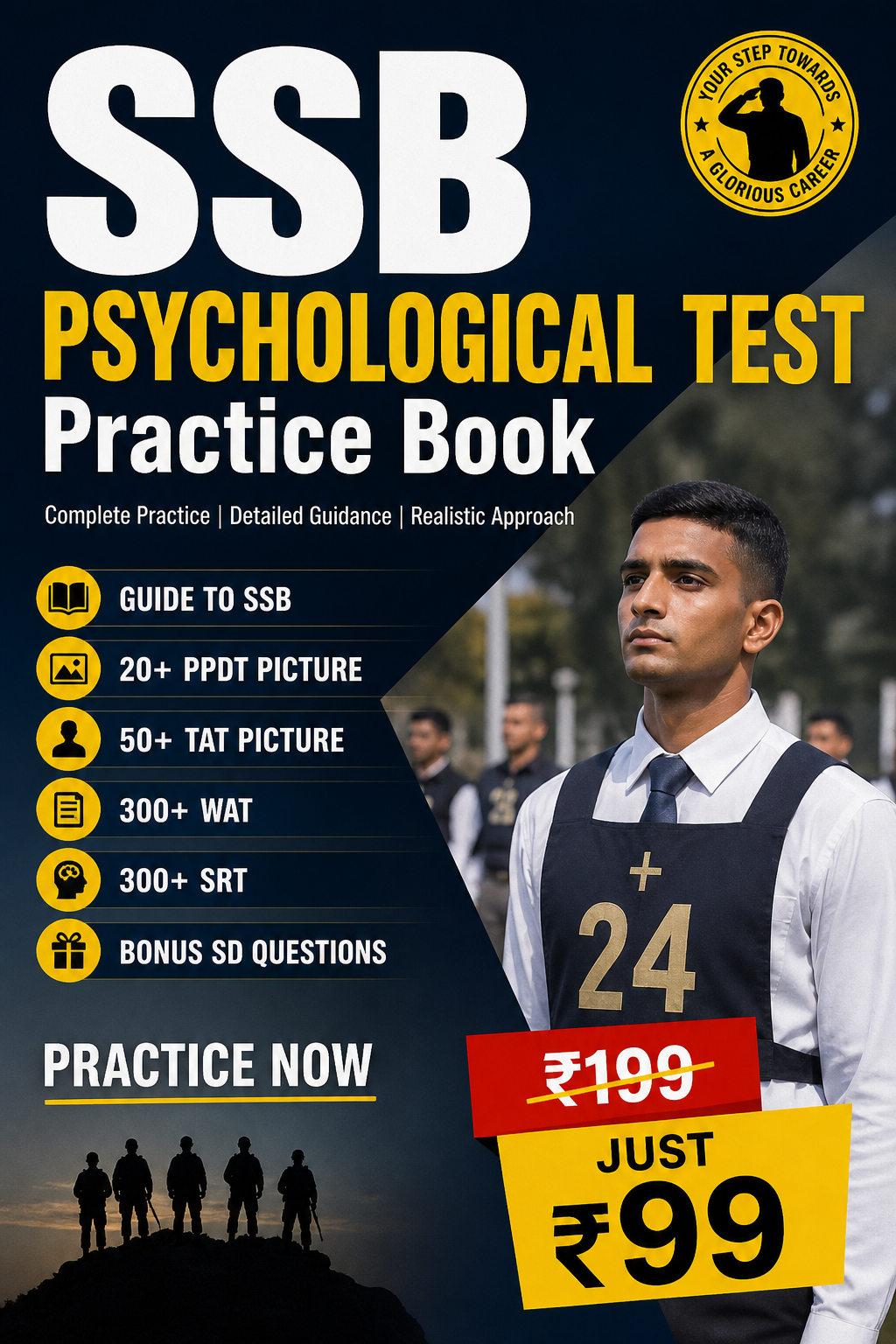
Stop Guessing. Start Practicing.
Get the ultimate SSB Psychological Test Practice eBook featuring high-quality original images, priority matrices, and strict observation frameworks. Build your authentic reflex before the real test.
Download Now for just ₹99Official Verification Sources
While we provide extensive strategic guidance based on practical experience, candidates must always verify testing schedules, reporting procedures, and eligibility criteria through the official military portals:
Frequently Asked Questions
1. Can I prepare themes based on my own life before the SSB?
Yes. Having a mental repository of your actual life experiences (e.g., college events, sports matches, family responsibilities) is highly recommended. The danger lies in memorizing exact word-for-word templates and forcing them onto unrelated pictures.
2. How do assessors know a story is pre-planned?
Assessors spot forced stories when the narrative drastically ignores the core stimulus of the image (e.g., writing a story about a war hero when the picture shows a simple classroom). It also becomes obvious when a candidate's TAT stories contradict their practical SRT responses.
3. Is it wrong to write a story about the military if I am a civilian?
It is not inherently wrong, but it is highly risky. Civilians often lack practical military knowledge, resulting in stories that sound like unrealistic movie plots. You are far more likely to show genuine organizing ability by writing about environments you actually understand, like academics or community work.
4. What if I can't think of anything and just freeze?
Freezing happens when you try to invent a "perfect" story. Lower your standards for perfection and rely on basic logic. What is the person in the image doing right now? What is the most practical next step they can take? Write that down immediately.
5. How do I practice spontaneous reactions?
Stop looking at images for minutes at a time. Force yourself to use a strict 30-second observation timer followed by a 4-minute writing timer. Use dynamic practice sets where you cannot predict the next image, forcing your brain to react organically.
Test Your Subconscious Reflex
Break free from toxic templates. Force your mind to react spontaneously using our strict, unpredictable 4-minute timed testing engine.
Read Next
Why Candidates Fail
Understand the fatal behavioral and psychological errors that instantly ruin a candidate's profile.
TAT Practice Set 1
Apply your new analytical skills immediately with our carefully curated practice images.
30-Day Psych Plan
A day-by-day framework to master the TAT, WAT, SRT, and Self Description tests from home.
Connect With The Community
Do not prepare in isolation. Join thousands of serious aspirants sharing insights and getting daily feedback.