Why Your WAT Sentences Must Align With Your PIQ Form
Every month, we see brilliant candidates get screened out. They have excellent communication skills. They speak fluent English. They have a massive vocabulary, and they write grammatically flawless sentences in their Word Association Test (WAT).
So, why do they fail?
They fail because they treat the SSB like an English literature exam. They memorize 500 "perfect" WAT sentences from a coaching center PDF and vomit them onto the paper. In doing so, they trigger the single most dangerous red flag in the entire psychological assessment: A massive disconnect between their subconscious reflex and their claimed reality.
The core of WAT PIQ alignment SSB psychology is simple: The psychologist does not read your WAT sheet in isolation. They read your WAT sheet while looking directly at your Personal Information Questionnaire (PIQ). Today, I am going to explain exactly how assessors use the WAT as a lie detector for your PIQ, and how you can naturally align the two.
What is the PIQ? (Your Psychological Blueprint)
Before we dive into the WAT, you must understand the gravity of the Personal Information Questionnaire. When you arrive at the board, you fill out this multi-page form. It contains everything about you: your parents' professions, your academic scores, your participation in sports, your hobbies, and your positions of responsibility.
Your PIQ is your claim. By filling it out, you are officially telling the board: "This is who I am. This is what I do."
However, anyone can lie on a form. Anyone can claim they are the captain of a football team or the president of a debate club. The DIPR assessors know this. Therefore, they do not blindly trust your PIQ. They use the psychological battery—specifically the extreme time pressure of the WAT—to verify if your claims are actually true.
The Alignment Verification Matrix
How the 15-Second Timer Exposes You
If you have 5 minutes to write a sentence about the word "TEAM," you can easily craft a beautiful, philosophical statement about leadership. But the WAT does not give you 5 minutes. As we detailed in our WAT guide, it gives you 15 seconds.
In 15 seconds, your conscious brain (the liar) shuts down. Your subconscious brain (the truth) takes over. The first thought that pops into your head is directly tied to your real-life experiences, habits, and environment.
Let us look at two stark examples of how this disconnect reveals itself to the assessor.
The Case of the "Fake Athlete"
Candidate A writes in his PIQ that he has been the captain of his college football team for three years. He claims his hobbies are running, fitness, and outdoor sports.
During the WAT, the word "SWEAT" appears on the screen.
Candidate A's Reaction: "Sweat smells very bad in the summer."
The Psychologist's View: The assessor looks at the PIQ, looks at the WAT sheet, and immediately flags the candidate. Why? Because a genuine athlete, someone who plays football every single day, does not associate sweat with a bad smell. A real athlete associates sweat with hard work, stamina, or victory on the field.
If the PIQ was true, a natural, un-coached response would have been: "Sweating in practice saves blood in war," or "Regular sweating through sports keeps the body fit." Candidate A's response proves he is a couch potato who lied on his PIQ.
The Case of the "Introverted Debater"
Candidate B wants to impress the board. He writes in his PIQ that he is the President of the debate club and frequently organizes massive public speaking events.
During the WAT, the word "STAGE" appears.
Candidate B's Reaction: "Stage fear is very common among students."
The Psychologist's View: Another massive red flag. A person who genuinely leads a debate club and speaks on stage regularly does not subconsciously associate the word "stage" with "fear." They associate it with expression, audience, or confidence. A naturally aligned response would be: "A stage provides a platform to inspire large audiences."
The Danger of the "Coaching Center PDF"
This is why reading "500 Solved WAT Words" PDFs from random internet forums is academic suicide. When you memorize sentences written by a 40-year-old retired officer, your WAT responses will sound like a 40-year-old veteran.
But the assessor knows you are a 20-year-old engineering student from a Tier-2 city. If your PIQ says you are a college student, but your WAT sentences sound like a war general reciting philosophy, you are marked as "Coached." The SSB rejects coached candidates because their true personality is hidden behind a fabricated wall.
You cannot borrow someone else's Officer Like Qualities. You must reflect your own.
How to Build True Alignment (Your Strategy)
If you want to ensure your WAT sentences perfectly mirror your PIQ, you must stop memorizing and start anchoring. Here is the three-step strategy to align your subconscious reflexes.
Step 1: The PIQ Audit
Sit down with a blank piece of paper and write down the three core identities of your actual life. What do you actually do? Are you a computer science student who loves coding? Are you an elder sibling who manages the household? Are you a district-level badminton player?
These core identities are your anchors. Every time a neutral or positive word flashes on the screen, your brain should automatically try to connect it to one of these three anchors.
Step 2: Generate Contextual Vocabulary
Let's say your real-life anchor is that you are an engineering student who loves organizing college tech-fests. Let's see how you can naturally align different WAT words to your reality:
- Word: PLAN -> "A well-structured plan ensures smooth execution of college fests."
- Word: SYSTEM -> "Updating the software system prevents technical glitches during events."
- Word: TEAM -> "A coordinated team handles backstage event pressure easily."
Notice how none of these sentences talk about war, border security, or fighting terrorists. Yet, they perfectly demonstrate Factor II OLQs (Organizing Ability, Reasoning, and Initiative) in a way that is 100% authentic to the candidate's real life.
Step 3: Neutralize the Negative
When negative words like "DEATH" or "FEAR" appear, do not panic. As we covered in our negative words guide, simply pivot the word into a factual observation or an actionable solution based on your reality. Do not preach. Just state a practical fact.
The Role of the Interviewing Officer (IO)
You must understand that the psychology test is not an isolated event. It is deeply connected to your personal interview.
If the psychologist detects a mismatch between your WAT and your PIQ, they will put a specific note in your dossier for the Interviewing Officer. The IO will then intentionally grill you on that exact topic to break your facade.
If your WAT revealed that you might have lied about playing football, the IO will not ask you broad questions. They will ask you highly specific, technical questions: "What is the exact dimension of a standard goalpost? What is the offside rule? Name the current captain of the national team."
If you falter, the IO confirms the psychologist's suspicion. Your integrity is compromised. And in the Armed Forces, a lack of integrity means instant rejection.
Final Words from the Mentor's Desk
The SSB is not looking for perfection; they are looking for truth. They want practical, adaptable human beings whose thoughts, words, and actions are in perfect harmony.
Stop trying to project a fake superhero image. Your ordinary, student life is full of daily responsibilities, challenges, and leadership moments. Draw your sentences from your own sweat, your own studies, and your own interactions.
Do not wait until the testing hall to see what your subconscious mind spits out. Force your brain into the 15-second pressure cooker today. Audit your PIQ, anchor your vocabulary, and practice until your responses reflect the undeniable truth of who you are.
Official Verification Sources
While we provide extensive strategic guidance based on practical psychological testing methodologies, candidates must always verify testing schedules and procedures through the official military portals:
Frequently Asked Questions
1. Can I write about defense scenarios if I am a civilian?
You can, but it must be realistic and used sparingly. If every sentence you write is about the Army, tanks, or terrorists, but your PIQ says you are a B.Com student, it looks incredibly artificial. Anchor your sentences primarily to your academic and daily life.
2. What if I don't have any major achievements in my PIQ?
The SSB is not looking for CEOs or Olympic medalists. They are looking for responsible citizens. If your achievement is simply maintaining good grades while helping your family manage a small business or doing daily household chores, anchor your WAT to those honest responsibilities.
3. Does poor handwriting affect the WAT evaluation?
Assessors are trained to read fast-paced handwriting. Your writing does not need to be beautiful, but it must be legible. If you write so fast that the sentence is completely undecipherable, it will be treated as an incomplete response.
4. What is considered a "learned response"?
A learned response is a universal idiom, quote, or generic fact that reveals nothing about the candidate's personality. Examples include "Honesty is the best policy," "Blood is red," or "Work is worship." Assessors ignore these entirely.
5. Should I use 'I' or 'My' in WAT sentences?
It is perfectly fine to use "I" occasionally (e.g., "I enjoy playing football"), but overusing "I" in every sentence makes you appear self-centered. Aim to write observational, factual sentences that imply your traits without repeatedly using first-person pronouns.
Execute Your Strategic Practice
Do not wait for the actual test to discover your subconscious reflexes. Use our strict, timed testing engine to anchor your words to your PIQ right now.
Read Next
WAT Complete Guide
A comprehensive breakdown of the 15-second cycle and how psychologists extract your traits from it.
Self Description Guide
How to write an authentic SD that perfectly aligns with your interview and psychology tests.
Why Candidates Fail
Understand the fatal errors that instantly ruin a candidate's psychological profile.
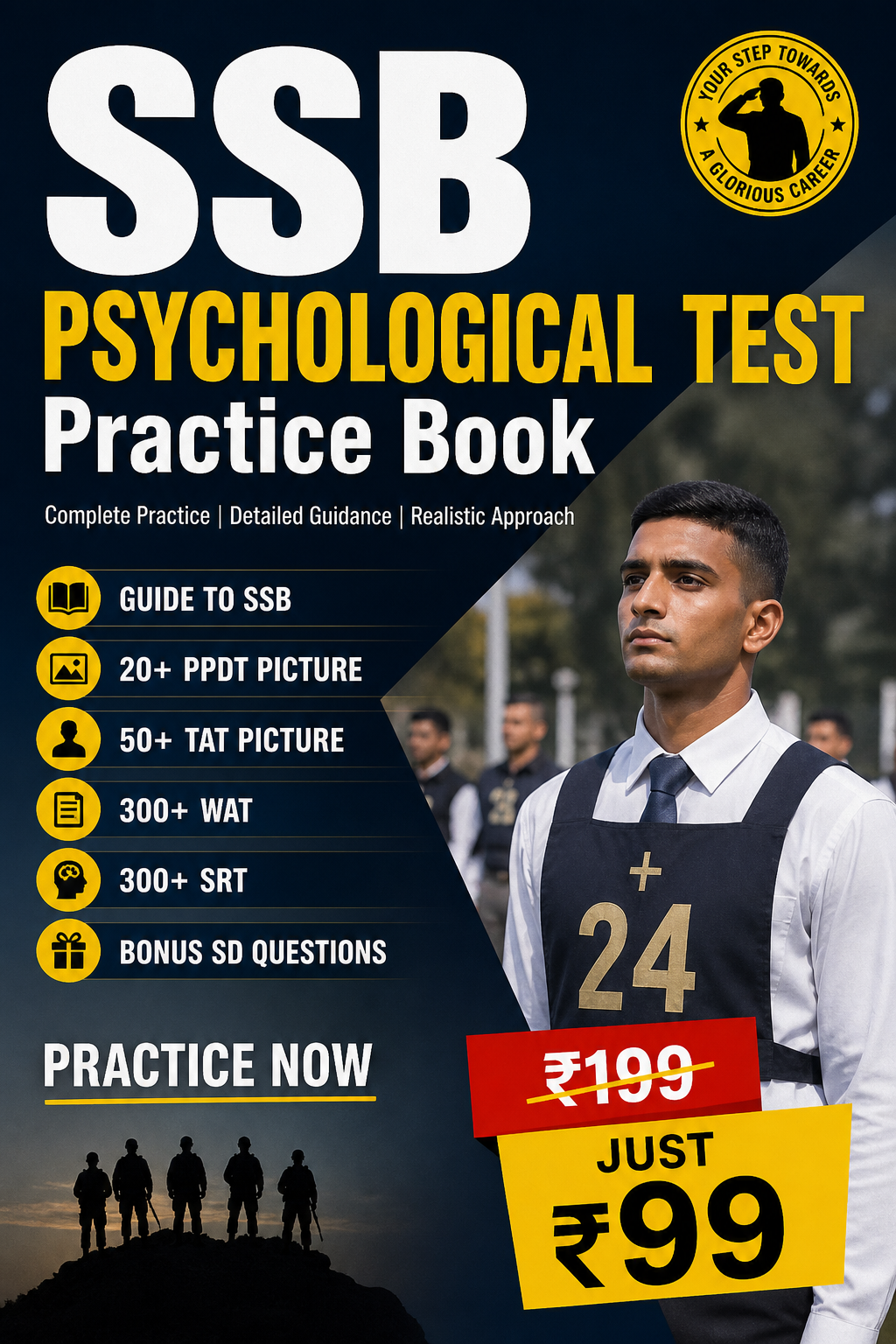
Stop Guessing. Practice What Actually Comes in SSB.
The ultimate practice-only workbook designed to build high-speed muscle memory for the exact SSB Pattern Based standard tests.
Connect With The Community
Do not prepare in isolation. Join thousands of serious aspirants sharing insights and getting daily feedback.
Join Our Official Discussion Group 👇
💬 Ask doubts 📢 Share feedback 💡 Give suggestions 🤝 Discussion & interaction
Enter Discussion Group