Cold Start in TAT: How to Overcome Blank-Page Anxiety Under Pressure
You are sitting in the testing hall. The lights dim. The projector clicks, and for exactly 30 seconds, a hazy, ambiguous picture flashes on the screen before you. It disappears. The lights snap back on. The buzzer blares, signaling the start of your 4-minute writing window for the Thematic Apperception Test (TAT).
You look down at your blank sheet of paper. You grip your pen. And suddenly, your mind goes completely, utterly blank. Ten seconds pass. Then twenty. Your heart rate spikes. You look around and hear the furious scribbling of fifty other candidates, which only amplifies your internal panic. By the time you finally force a thought onto the paper, a full minute is gone, and you are rushing to write a disjointed, poorly structured story just to beat the clock.
If you have experienced this, you are not alone. In psychological and performance circles, this is known as a "Cold Start" or "Blank-Page Anxiety." It is one of the most brutal hurdles a candidate faces in the SSB interview, and it is the leading cause behind incomplete dossiers. Today, as part of our ongoing masterclass on SSB psychology strategy, I am going to teach you exactly why this happens and provide you with actionable frameworks to never freeze again.
The Psychology of the Freeze Response
To defeat the enemy, you must first understand it. Why does your brain, which is perfectly capable of writing a story in the comfort of your bedroom, suddenly shut down in the testing hall?
The answer lies in the amygdala—the part of your brain responsible for the fight, flight, or freeze response. When you are placed under strict time pressure and you know that your career dreams hinge on your performance, your brain perceives the TAT test as a "threat." In many candidates, this triggers the "freeze" response. Your prefrontal cortex (the logical, creative part of your brain) gets temporarily hijacked.
Furthermore, candidates suffer from perfectionism. Instead of writing the first logical observation that comes to mind, they filter their thoughts: "Is this story good enough? Does it show leadership? What if the assessor thinks I'm negative?"
While you are busy filtering and judging your own ideas, the clock is relentlessly ticking.
Strategy 1: The "First Thought" Protocol
The core objective of the TAT, as designed by the DIPR (Defence Institute of Psychological Research), is to access your subconscious mind. Assessors do not want a perfectly polished piece of fiction; they want your raw, immediate reaction to the stimulus.
To overcome the cold start, you must implement the "First Thought Protocol." The moment the picture appears, whatever logical, practical scenario first pops into your head is what you must write about. Do not discard it looking for something "more heroic."
The Protocol in Action:
Picture: A man standing near a bicycle with a flat tire.
Candidate's First Thought: "He's late for college because his cycle broke down."
The Perfectionist Trap (Do Not Do This): "No, that's too simple. Maybe he's an army spy and the cycle has a bomb."
The Protocol Execution: Accept the first thought. Make him a college student, have him fix the tire using a nearby repair shop or a portable kit, and reach his exams on time.
By accepting your first logical thought, you instantly bypass the filtering process and give yourself the full 4 minutes to execute the Past-Present-Future structure.
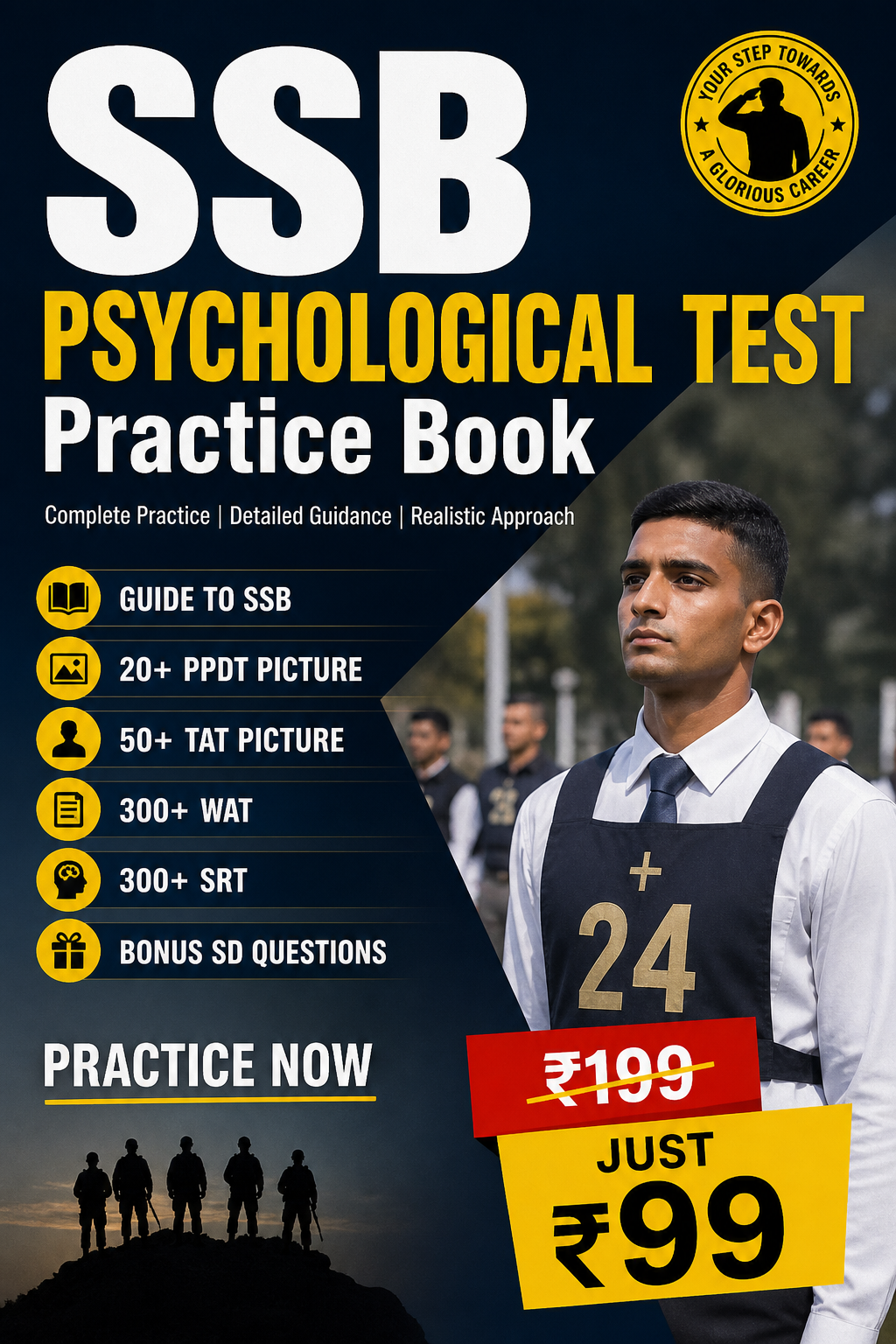
Stop Guessing. Practice What Actually Comes in SSB.
The ultimate practice-only workbook designed to build high-speed muscle memory for the exact SSB Pattern Based standard tests.
- Strictly based on real past SSB situations & pictures.
- Zero theory fluff. 100% action-oriented practice pages.
- Printable PDF format — download instantly & start solving.
Strategy 2: The 5-W Framework for Instant Structuring
If the "First Thought" protocol still leaves you staring at a blank page, you need a mechanical fallback. When creativity fails, fall back on structure. Treat the 30-second observation phase as an intelligence-gathering mission.
Instead of trying to "invent" a story, simply answer these five mechanical questions in your head during those 30 seconds:
- Who: Who is the central character? Assign them an age and profession that aligns with your PIQ form.
- What: What is happening right now? (The immediate observation).
- Where: Where is the location? (Urban, rural, indoors, highway).
- Why: Why are they in this situation? (The core problem or objective).
- How: How are they going to fix it? (The action steps).
By the time the lights come on, you already have the skeleton of your story. All you have to do is transcribe the answers to those questions into flowing sentences.
TAT: The Freeze vs. The Flow State
Strategy 3: Breathing and Grounding Techniques
Blank-page anxiety is a physical reaction as much as it is a mental one. When the buzzer rings, cortisol floods your system. If you immediately stare down at your blank paper, the vast white space acts as an intimidation tactic.
During the 30-second observation phase, perform tactical breathing: inhale deeply through your nose for 4 seconds, hold for 2, exhale through your mouth for 4. Keep your eyes firmly locked on the projector screen, not your paper. Absorb the details of the image. The moment the light comes on, do not hesitate. Touch your pen to the paper and write the name of your hero immediately.
Action cures fear. The simple physical act of writing a name (e.g., "Rahul, a 21-year-old...") breaks the mental barrier. Once the hand starts moving, the brain follows.
Strategy 4: Pre-Structuring the Blank Slide
The ultimate test of a cold start is the 12th TAT slide—the infamous blank slide. There is no picture, no stimulus, just pure imagination required on command.
The secret to overcoming blank-page anxiety here is simple: you should never be anxious because you already know it is coming. As we discuss in our deep dive on mastering the blank slide, you must have a pre-structured narrative ready for this specific slide. It should ideally be an incident from your own life that highlights your core strengths, adapted to fit the TAT format. The 12th story is your anchor; it is the one story where a cold start is completely avoidable through prior preparation.
The Bottom Line: Desensitization through Practice
The only permanent cure for blank-page anxiety is desensitization. You must expose yourself to the stressor so often that it becomes mundane.
You cannot cure this by reading books. You must practice under strict, unyielding time pressure. By utilizing a digital testing engine that forces you to observe for 30 seconds and write for 4 minutes, you train your amygdala to stay calm. Over time, the buzzer will stop sounding like an alarm and start sounding like a starting pistol.
Take control of your psychology today. Jump into our timed practice sets and conquer the cold start.
Execute Your Strategic Practice
Do not let the real testing hall be the first place you face the 4-minute timer. Desensitize yourself using our strict testing engine right now.
Frequently Asked Questions
1. What if my "First Thought" is negative or tragic?
If the picture objectively depicts a tragic scene (like an accident), accepting the negative premise is fine. Your story becomes "positive" through the actions your hero takes to rescue, mediate, and solve the tragic situation, not by pretending the tragedy didn't happen.
2. Does bad handwriting from rushing affect my score?
Yes, indirectly. Assessors are trained to decipher fast handwriting, but if a cold start causes you to rush so much that your words become entirely illegible, the assessor simply cannot evaluate your Officer Like Qualities. Legibility is crucial.
3. Should I leave a few lines blank if I can't finish in time?
Never sacrifice the observation time of the next slide to finish the previous story. When the buzzer rings, stop writing immediately, even if mid-sentence. Failing to observe the next slide will trigger a domino effect of cold starts for the rest of the test.
4. I often freeze during WAT as well. Does this strategy work there?
Absolutely. The Word Association Test (WAT) gives you only 15 seconds. The "First Thought" protocol is even more critical here. Write down your immediate reaction rather than trying to construct a profound, grammatically complex sentence.
5. What if the picture is too blurry to use the 5-W framework?
The haziness is intentional. It forces projection. If you cannot identify the exact background, invent a logical one. Decide quickly if it is an office, a street, or a home based on the rough outlines, and commit to it. Indecision is what causes the freeze.
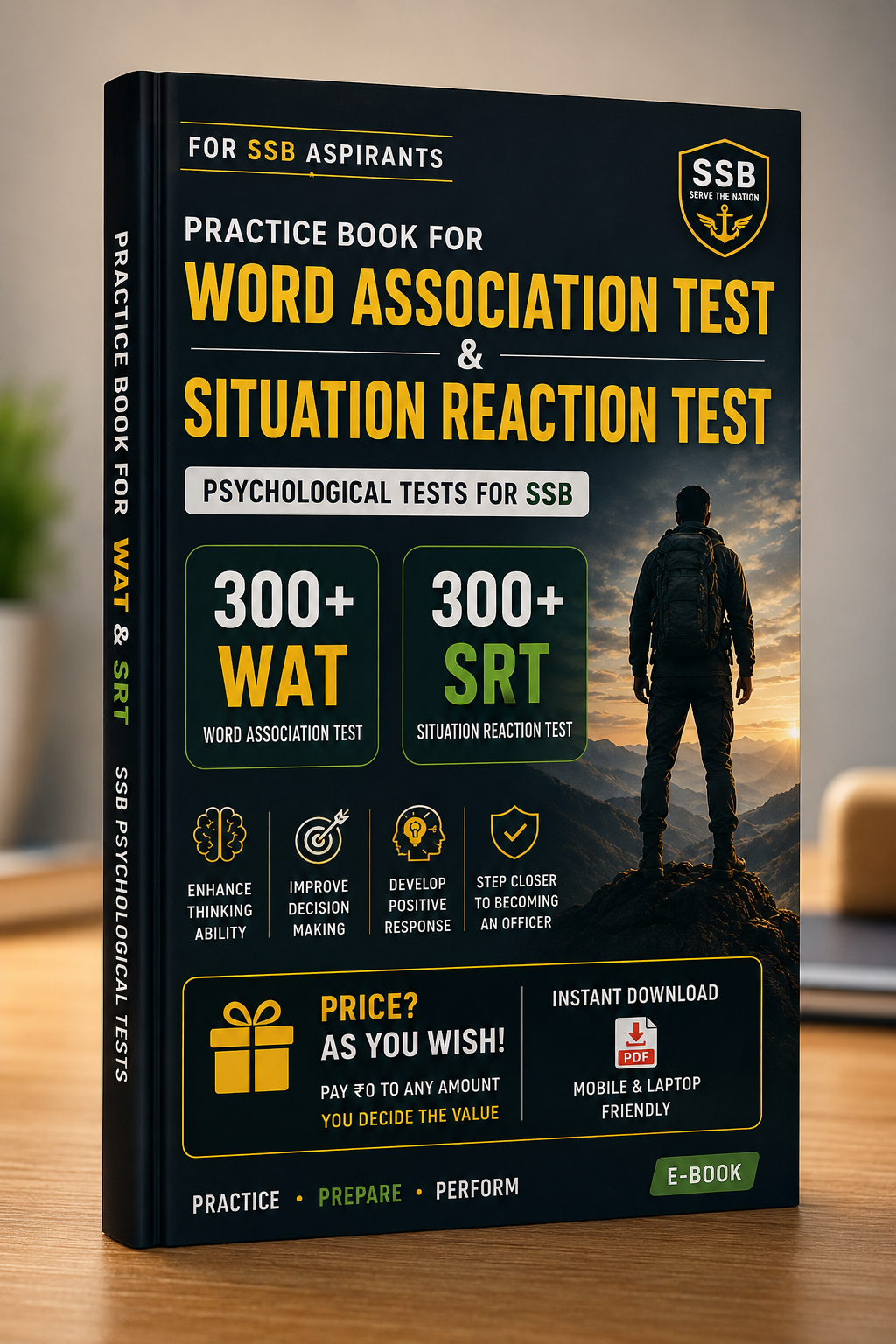
WAT & SRT Practice eBook (300+ Sets)
No long theories, just pure practice. I've put together over 300 WAT words and 300 SRT situations formatted exactly like the real SSB boards. Perfect for timing your practice sessions at home.
Price: As Your Wish!
You decide the value. You can enter ₹0 to download it for free, or support my work by paying whatever amount you feel is right.
Read Next
SRT Time Strategy
Discover how to manage the intense pressure of 60 situations in 30 minutes without leaving any blanks.
Mastering the Blank Slide
The 12th TAT slide requires preparation. Learn how to draft an anchor story based on your genuine real-life achievements.
The 3-Part TAT Formula
Implement the 20-50-30 ratio to build an unshakeable Past-Present-Future structure within exactly 4 minutes.
Connect With The Community
Do not prepare in isolation. Join thousands of serious aspirants sharing insights and getting daily feedback.
Join Our Official Discussion Group 👇
Ask doubts Share feedback Give suggestions Discussion & interaction
Enter Discussion GroupOfficial Verification Sources
While we provide extensive strategic guidance based on practical experience, candidates must always verify testing schedules and procedures through the official military portals: Indian Army, Indian Navy, and Indian Air Force.